
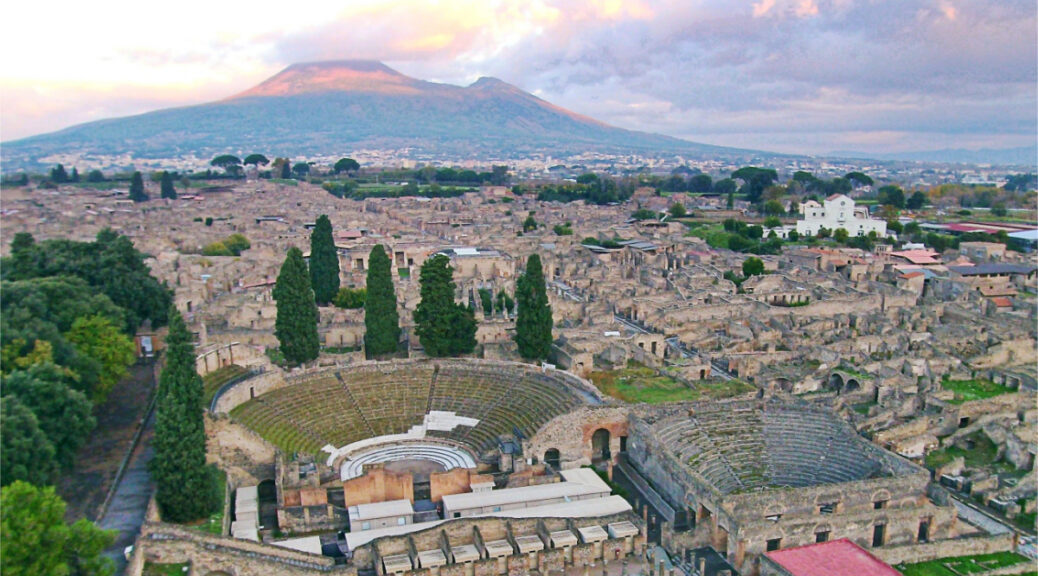
Berkshire Archaeological Society lecture – 25 April 2026
Dr J. W. Hanson (University of Oxford)
After introducing himself, Dr Hanson started the lecture by saying why this question? It is because demography is important and the size of cities matters to those who live in them.
The Importance of Scale
There is a strong relationship between the number of people and social structure. Dr Hanson showed two graphs:
- Population plotted against US Metropolitan Road Surface. As the population increases, the greater the road surface area. Bigger cities use infrastructure more efficiently.
- Population plotted against US Metropolitan GDP (Gross Domestic Product). As the population increases, the greater the GDP.
The population size of cities can be plotted against many other factors, including social and cultural aspects. With most, if not all factors, there is an exponential increase as a function of population size. An example is during the covid lockdowns, where a population twice the size of another, had more than twice the increase of infection rate.
This theoretical model can be extended to ancient cities. We do not generally have population size data, apart from e.g. census data from some ancient Egyptian cities, although these usually only included the number of men. However, there are several other methods that can be used to estimate the population sizes of ancient Roman cities, such as by the amount of seating in amphitheatres and the capacity of aqueducts. It is important to know the population size of Pompeii, to better understand the social and cultural development of this settlement.
It is also important to understand the effects that cities have on their surrounding environs, as items such as building materials and food are generally sourced from outside of the cities themselves. Ancient cities had lower birth rates and larger death rates, due to factors such as greater crime and diseases in cities making them highly reliant on continued immigration, including slavery, to maintain population levels. Hence, estimates of the population of ancient cities can also help us to better understand the dispersal of populations between rural and urban landscapes over time and their relative living standards. We should not forget that there is a moral component to this research.
Over time, the estimated population of Pompeii has changed, with early estimates of 8,000 – 10,000 and more recently much larger figures of 35,000 – 45,000. Statistical models are used in ascertaining the approach to risk. It is always advantageous to estimate a range of values, rather than a single figure. The way in which we respond to figures is important and confirmation bias often plays a part. This is where humans tend to favour, interpret and remember information that confirms their pre-existing beliefs, ignoring or dismissing contradictory evidence.
The New Inscription
A monumental tomb was discovered in Pompeii approximately ten years ago. It has four curved sides and is made of white marble. It has a 4m long inscription, that includes information of a gladiatorial contest with 416 gladiators, 456 three-sided couches, with 15 people per couch. From this and other information such as the distribution of wheat, especially during a famine, it leads to an estimation of the population of Pompeii being 30,000, and up to 45,000 including slaves. However, these numbers do not work. They equate to 400 people per hectare, which is equivalent to modern Mumbai and is too large to be sustainable. It is likely therefore, that the numbers for the gladiatorial contest were for an entire year, rather than for a single event.
Inhabited Area
We do know the inhabited area of Pompeii as well as the number of houses (1,100 units excavated to date) and their sizes, although we don’t know how many people lived in each house. Not all of Pompeii has been excavated, but if we take an average number of five people per house, the estimated population is up to 8,000.
Improving Population Estimates
If we look at the various Roman cities across the Roman Empire, the relationship between the inhabited areas and estimated populations increases exponentially, i.e. as each city increases in size, the population also increases. From this, an equation has been extrapolated to estimate the population size in other cities. At Silchester for example, there was a low number of residential units and a larger number of public buildings. However, the residential buildings were built from materials inferior to the public buildings, so not all may have survived, and certainly today, there are a lot of gaps with no trace of buildings. An estimate of approximately 140 – 200 houses is too low. If we measure the capacity of the infrastructure in Silchester to estimate the population size, there is a reverse relationship. By looking at other factors such as the size of the amphitheatre (it had seating for 700+ people), the forum, streets, gates and the total area, this results in different population estimates for each factor. But we can work out the maximum (6,000), minimum (1,000) and average figures, with the number of individuals likely to be closer to 6,000.
This research of the Pompeii population used 35 factors including the capacity of aqueducts, the number of gates, the temples, the basilica, two amphitheatres and the baths. This results in a scatter of population size estimates on the graph. While this looks messy, we can conclude that Pompeii is unlikely to have had a population size of less than 2,000 or greater than 20,000. The range is between 8,000 – 12,000, with an average figure of 10,000, which of course is the population size that has long been held to be the case.
Recommended books
‘The Human Tide: How Population Shaped the Modern World’ by Paul Morland.
‘The Uncertain Past: Probability in Ancient History’ edited by M. Lavan, D. Jew and B. Danon.
report by Debbie Cousins
image: Pompeii Theatres by ElfQrin (Wikimedia Commons)