
by Professor Richard Bradley, 18th October 2025
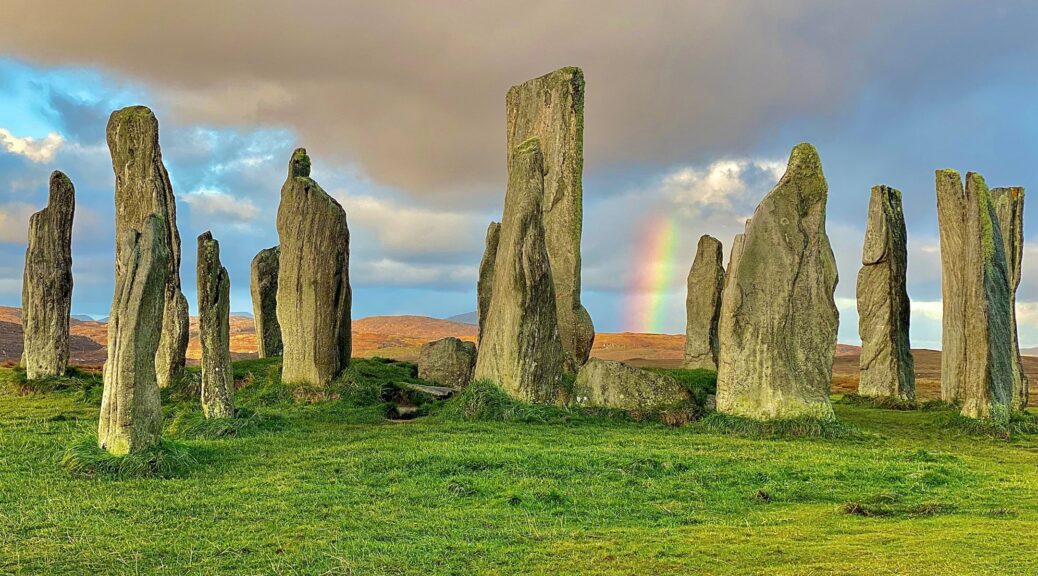
Professor Richard Bradley described his very long journey to Calanais, which is situated on the west side of the Isle of Lewis, Scotland, and how it had raised questions about the difficulties that prehistoric people, travelling from elsewhere in the British Isles, would have had to get there. He told how the engineer, Alexander Thom, on a sailing holiday, sought shelter from a gale in an inlet. When the storm had passed, Thom looked up to see the Calanais stones, outlined against the sky, on high land above the safe harbour. This, apparently, was what inspired Thom’s studies in archaeoastronomy.
We looked at the unique design of the Standing Stones of Calanais; a stone circle, with radiating stone rows and an avenue, looking rather like a Celtic cross, and with the remains of a burial chamber within the circle. We looked at stone monuments at Kilmartin Glen on the west coast of Scotland, and saw the rock art found at some sites; pecked cups and rings, as well as inscribed lines. We looked at some of the many stone circles at Machrie Moor on the west coast of the Isle of Arran, where some stones had been sourced from non-local places, and where the summer solstice sunrise could be observed.
Richard talked of the elements that these sites had in common; their situation on west coasts, best approached by sea and rivers, with a sheltered harbour nearby, and their isolation, with no nearby settlements. Other common elements included shared architectural features; upright stones set in a circle, combinations of raw materials; stone sourced from distant places as well as locally, and emphasis on the sky; the sun, possibly also the moon.
We looked at comparable monument complexes elsewhere in Scotland, such as the three Bronze Age Clava Cairns near Inverness. The two outer chamber cairns were used for burials, and their entrances were aligned southwest to the midwinter sunset. All three cairns are surrounded by stone circles, and here the stones vary in height with the tallest oriented to the southwest, facing the sunset. The cairns’ kerb stones appear to have been selected for size and colour, with larger red stones on the southwest side and smaller white quartz stones on the northeast side.
We looked at Neolithic sites on Mainland Orkney, starting with Maeshowe Chambered Cairn. One photograph showed the sunbeam from the midwinter solstice lighting the passageway to the burial chamber. Richard told of his Maeshowe ‘experience’; being locked in at night for a week, when the chamber was empty of tourists, in order to examine the wall stones for decorations, using a torch and a step ladder. He said it was rather cold!
We looked at the Stones of Stenness and the Ring of Brodgar, both with tall, thin standing stones, some with their tops cut at an angle. Similar standing stones were seen at a Machrie Moor stone circle. The Ring of Brodgar has been found to contain stones brought from distant Orkney islands, as well as local ones. We also looked at the Ness of Brodgar, with its large stone buildings having similar architecture to burial chambers, but with much animal bone evidence of feasting by the living, rather than human bone evidence of burial of the dead. All of these monument complexes, grouped together on Mainland Orkney, would have been accessed with some difficulty from the sea, via lochs and narrow channels, by prehistoric people visiting from outside of the Orkney Islands.
From Orkney in Scotland, we went to the Boyne Valley in Ireland. Here the monuments are situated a long way upriver, isolated on a ridge in a bend of the River Boyne. Newgrange passage tomb is famous for its alignment with the midwinter solstice, when the sun illuminates the inner chamber. It is also ringed with a stone circle, has stones from distant parts of Ireland, and elaborate rock art, making it comparable to the other sites discussed today.
We looked at an aerial photograph of Newgrange and its surroundings during a drought, and saw the crop marks of many structures no longer visible, including what looked to have been a huge palisade, which Richard said is now known to completely encircle Newgrange.
Moving north, we looked at Ballynahatty, once isolated, but now situated in a suburb of Belfast. The huge Neolithic henge, with the remains of an earlier tomb in the middle, was likely accessed from the nearby River Lagan. At Balregan, a burial mound within a stone circle was similarly isolated, and similarly accessible from a river.
Richard discussed the architectural features that the various sites shared. Thus, a ground plan of post holes found at Ballynahatty; two concentric circles, with an entrance gap, and a four-post square in the centre, was similar to that found at Newgrange, albeit smaller. He pointed out the combinations of raw materials; stones sourced from different locations, as found at the Ring of Brodgar and Newgrange. Also, the emphasis on the sun, seen in alignments of solstices to the centre of tombs, as seen at Maeshowe Chambered Cairn and the two Clava Cairns burial chambers.
We briefly looked at the rock art found at sites in Ireland and Scotland. We looked at aerial photographs of some of the sites mentioned in today’s talk, seeing their relations with rivers and the sea. We saw a photograph illustrating the prominent position of Knowth passage tomb high above the River Boyne. It brought to mind the photograph seen earlier, of the Standing Stones of Calanais, outlined against the sky, high above the sheltered inlet.
Richard talked of the long-distance links between the various monuments, as seen in shared features, such as their emphasis on the solstices, and the combinations of local and non-local materials used in their building. Also, the non-local imagery, such as the rock art seen at Newgrange, Ireland and Kilmartin, Scotland, could suggest long-distance connections. We looked at a map of the British Isles, showing sea routes around the coasts, which may have been used by prehistoric people to travel to the monument sites.
Richard talked about the long, difficult journeys travelled by people who may have displayed their shared beliefs in the shared architecture of their monuments. These journeys may have been pilgrimages, or possibly even rites of passage.
Richard ended the talk by telling of another ‘sacred’ journey; that of the 2012 Olympic torch. As part of its relay journey through the UK, which included visiting Stonehenge, the torch, carried by Commonwealth gold medallist Kirsty Wade, travelled up the stormy west coast of Scotland to Calanais… and blew out!
Report by Joan Burrow-Newton