
Part of a series of bulletins from the BAS excavations at Wickham House
Follow the project on our YouTube channel
Attendees: Stuart, Julian, James P, Ben C, Gill, Emily, Sofia, Geoff, Carrollanne, Lindsey, Philip, Phil C, Martin, Andrew R, Peter and Keith
In Trench 15 Martin, Keith and Geoff focussed on extending the horizon of archaeology across the northern end of the trench where the southwest corner of a Roman period timber framed building is projected to extend. The northeast corner of this building was discovered nearby in 2025, and a key objective for this season is to understand the relationship between this building and the intersection of the lane/Roman road. Not only did this involve several hours of hard mattocking, but cleaning the surface revealed and sieving using a trowel.


The volume of spoil created from Trench 15 also kept Julian busy during the breaks keeping up his regular “patrol” of the spoil heap looking for metal artefacts overlooked! Back in Trench 17 Julian and Carrollanne manged to removed the layer of flints lying on top of a deposit of “dark earth” containing Roman pottery, bone and slag. Tomorrow the plan is to remove the “dark earth” in spits to assess whether there further archaeology lying beneath as predicted by the Ground Penetrating Radar…

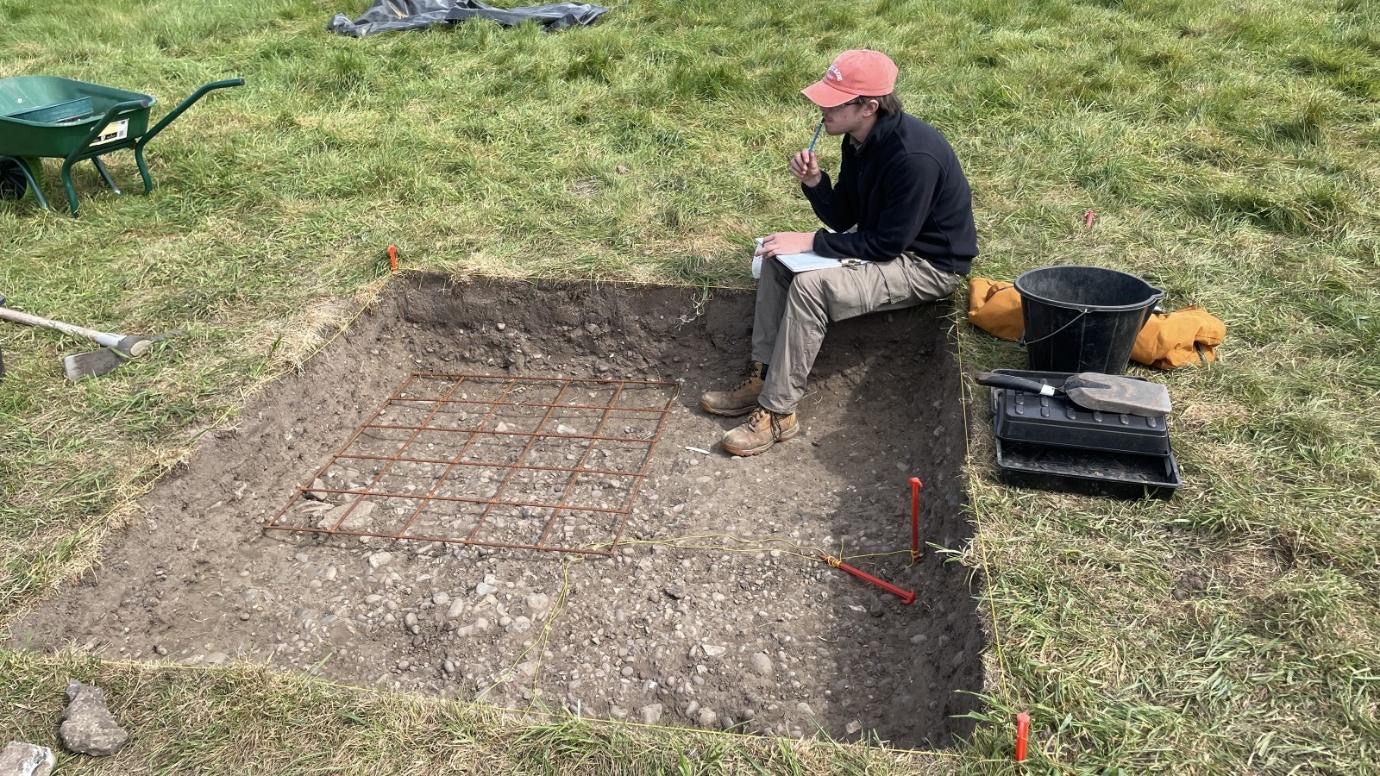
Today was a busy day in Trench 16! Ben completed recording the pebble layer revealed the day before and began a sondage to explore the deposits beneath the pebbles to assess how far features seen to the west of Trench 16 extended to the east.
Stuart and Lindsey continued to explore the area of possible burning at the southwest end of the masonry structure, whilst James cleaned up the slot across the masonry structure excavated in 2025. Whilst the presence of a furnace in the southwest has still to be confirmed, James and Stuary revealed evidence of the collapsed flue in the section which now strongly suggests that the masonry structure revealed is part of a flue. The flint shown in Figure 5 not only has been exposed to heat but has a layer of plaster and a thick covering of ash – and may have been part of the now collapsed roof of the flue.
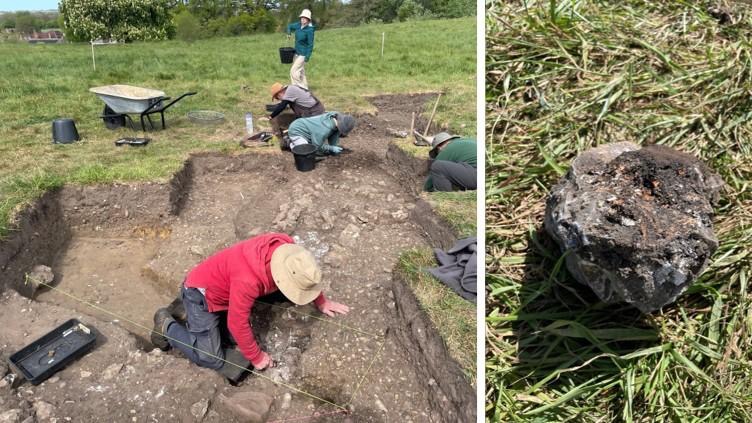
Emily and Sofia cleaned up the surface to the north of Trench 16 revealing a linear cut of a possible construction trench aligned with the masonry flue, whilst Phil C explored a possible return of the flue to the northeast.


To the southeast of the excavation site, Philip, Andrew R, Gill and Peter continued with the high resolution (0.5m) earth resistance geophysics survey to assess the extent of roadside settlement to the southeast along Ermin Street.
