
Part of a series of bulletins from the BAS excavations at Wickham House
Follow the project on our YouTube channel
Attendees: Joanne, Martin, Julian, James P, Chloe, Doug, Nick, Rod, Lindsey, Geoff, Phyllida, Tim L, Merrill, Gordon, Jill, Beth, Jean, Alessa, Claire, Peter Cl and Keith
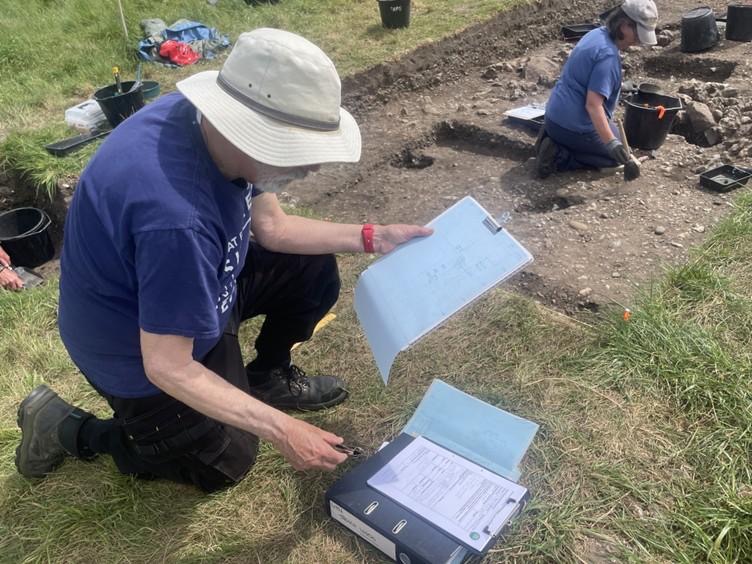
In Trench 15 Beth and Jill continued to excavate at section across the northerly ditch of the Roman road, which revealed a number of fills not seen further to the southeast in 2025. At the northern end of Trench 15 Martin, Merrill, Rod, Gordon, Joanne and Peter continued to explore the multiple layers of cobble/flint. Whist there are ephemeral hints of (what is thought to be) the possible foundations at the SW corner of Building #3 starting to emerge, further careful excavation is needed to define these features before an clear interpretation can be reached. Meanwhile Keith completed the latest plan of this area assigning new context number of the features being identified by the excavators.


In Trench16, Lindsey continued to define the morphology of the corn drier flue and the beam slot, whilst James continued to examine the newly revealed chalk/flint/sarsen deposits to the east. More work is needed to explain the stratigraphy of this area of the site, but careful excavation and recording is slowly bringing the archaeological remains into focus…

Once again we were very lucky to be joined by Phyllida, who was able to capture both the archaeology and the archaeologists at work in Trench 16 in her wonderful drawings. These artistic interpretations of the site offer an interesting contrast to highly technical drawings being plans of the same trench being meticulously recorded by Tim L (who is also a keen amateur artist!) nearby…

In Trench 17 the “benching” was completed, so work continued to clean up the vertical walls of the trench ready for section drawings to be recorded in the coming week. Doug was able to achieve a flat surface of the southerly trench wall, that when damped down, revealed previously unseen subtle stratigraphy in the midden deposits that can be correlated with the material culture artefacts previously discovered.

In Trench 18 Alessa, Jean and Claire completed the recording of the three contexts revealed the previous day, and then started a 50% section across the context of large flints seen in the geophysics survey. This was revealed to be a shallow deposit of flints on top of a continuation of the orange clay/gravel surface to the north that has been initially interpreted as the surviving surface of the Roman road. By the end of the day, this orange clay gravel surface was found to extend across the full length of Trench 18 suggesting that the road opposite this industrial area to the north is much wider than seen to the NW and SW of the settlement. Work will continue next week to locate the southerly ditch of the Roman road…
