
by Professor Katie Sampeck, University of Reading
Professor Katie Sampeck started her talk by telling us that her 4-year research project was coming to an end, and that today she was going to give us an overview of what she and her colleagues, in Britain and El Salvador, had been working on.
We learned how cacao pods, containing the seeds (beans), from which chocolate is made, are grown. Cacao trees, although tropical, require shade, and, having been domesticated, require human help to grow, taking eight years to fully mature and produce cacao pods. We looked at a ripe cacao pod, full of seeds covered by fleshy white fruit, which Katie told us was delicious, with a ‘tropical’ taste, rather like mango.
The seeds and flesh, when removed from the pod, are left to ferment. Cacao ‘wine’ can be made from the fermented liquid, after the beans have been removed for drying and then roasting. Katie explained that because fermenting can start while the pod is still attached to the tree, the processes of fermenting, drying and roasting of the beans must be done by cacao farmers, with sacks of the roasted beans then sent elsewhere for processing into chocolate.
The next step in the process is the winnowing of the roasted beans to remove the shell. Then comes grinding, with cocoa butter being extracted from the cocoa mass with a press. Next is conching, which could take hours or days of mixing, and is the stage at which other ingredients, such as vanilla, are added. Finally comes tempering, where the mixture is cooled, warmed and then cooled again, to give chocolate with a smooth, crisp texture.
Katie told us about the International Cocoa Quarantine Centre at Reading University, which most of us ‘locals’ never knew existed! We learned about the experimental archaeology of cacao harvesting and processing. We watched a video of the harvesting of cacao pods, using a replica of an ancient tool. The pods’ short stems are attached directly to the tree trunk, just above the small white flowers of the next crop of pods, so great care is needed when hand picking individual pods.
We looked at a map showing the major cacao growing zones in Central America and Mexico. Katie then told us of places where there is archaeological evidence of ancient people growing and processing cacao. Thus, at the Rio Ceniza Valley, El Salvador, there is evidence of human activity from about 1800 BCE to the 19th century CE. Using documentary evidence from the British Library, other world archives, as well as local archives, archaeologists have been able to study ancient cacao cultivation, processing, trade and consumption.
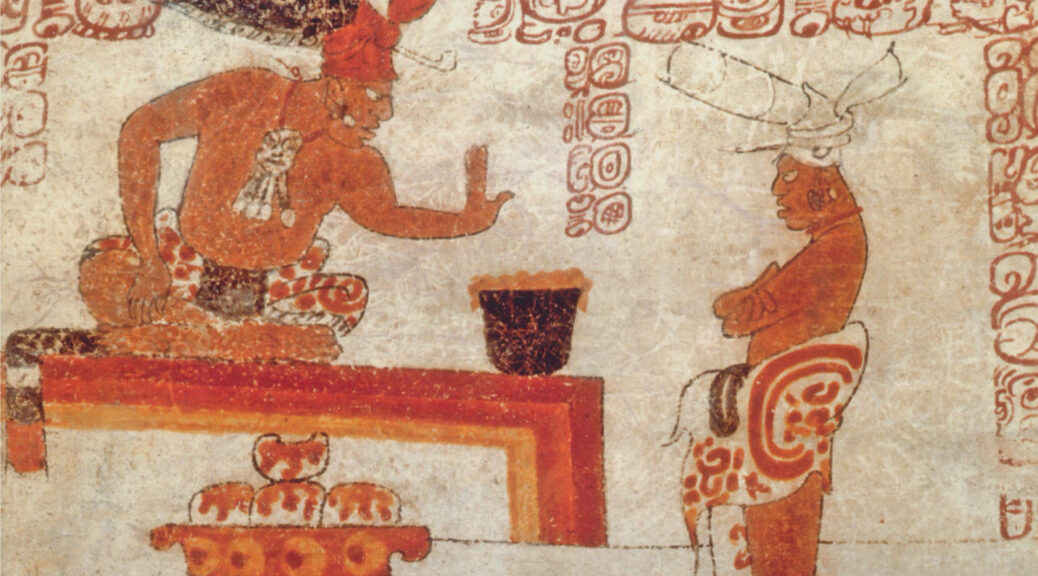
With cacao growing and the processing of chocolate being a lengthy and expensive business, the end product was reserved for the ancient elite, for religious rituals and ceremonies, and with cacao beans also being used as money.
We looked at a page of a Late Postclassic codex; a screen-fold book, made of deerskin parchment, with a depiction of the Lord of Death (with grinning skull), meeting Centeotl, the maize deity (symbolising life), under a cacao tree. Later, we were to learn of a dance, where a pot of drinking chocolate was balanced on the female dancer’s head, that was still part of modern wedding celebrations.
We looked at some previous cacao research. Thus, artefacts from numerous sites in Mexico, Central and South America, had been examined for residue containing ancient DNA, with a vast range of cacao species found. Ancient texts had been studied, and the fish-shaped hieroglyph for cacao (‘kakaw’), was identified.
The earliest evidence for cacao consumption, of about 1100-700 BCE, is from South America. We looked at a ceramic pot which had a long, thin neck. The pot had cacao pod shapes hanging from it, just like the pods that hang from a cacao tree trunk. From Mesoamerica, we saw another long-necked bottle, dated to 1150-900 BCE, and two round, wide necked, spouted vessels, dated to 900-600 BCE.
Katie told us about the biomarkers that are used to identify ancient vessels that have been used for preparing or consuming cacao. The biomarkers are theobromine (most commonly found), caffeine (often found) and theophylline (often found, sometimes by itself).
To study the biomarkers found absorbed into the ceramic insides of ancient vessels, molecular analysis is needed. Katie described the sampling process used on a pot donated for research; a wedding gift chocolate pot from Oaxaca, which had only ever been used to hold drinking chocolate. She was interested to discover that if samples were taken at 1cm intervals from the rim all the way down to the base, theophylline was only found near the rim. Katie wondered if theophylline was particularly good at creating the froth formed by whisking hot chocolate.
The Isla de Sacrificios, Mexico, now a natural reserve, was a funerary and ritual site in the Postclassic period (900-1521 CE). In 1844 the British Museum acquired some 1500 artefacts, enabling Katie’s present-day study of the material culture of the area.
Using vessels found in ritual contexts on the Isla de Sacrificios, molecular analysis studies showed that of the 24 vessels tested, 12 were found to contain the cacao biomarkers of theobromine and/or theophylline. The vessels had a variety of shapes, including spouted pots, bowls and cylinder vessels, now ‘proven’ to be associated with chocolate consumption.
We learned about the historical preparation and serving of chocolate. We looked at a 1687 French print of a man rolling and grinding cacao beans on a heated plate, to make the chocolate paste for kneading. We saw a video demonstrating the kneading process. A 1652 still-life painting showed a lidded chocolate pot. A hole in the lid for the handle of a spoon or whisk enabled the drink to be kept hot while the froth was made.
We also looked at a Cacao Recipe Dendrogram, seeing how recipes varied within countries, and also over time. For example, in England in 1682, a variety of cacao recipes were used. Also, a cacao recipe from 1591 Mexico was seen to be different from recipes used in Mexico in 1615.
Modern chocolate production, including the addition of soy lecithin and large amounts of sugar, was briefly discussed. Fortunately, today (unlike during my childhood!), there is good quality chocolate available in Britain. At the end of Katie’s talk there was a chocolate tasting session, which sadly, those of us at home on Zoom missed!
Report by Joan Burrow-Newton