
Part of a series of bulletins from the BAS excavations at Wickham House
Follow the project on our YouTube channel
Attendees: Philip R, Nick, Stuart, Lindsey, Martin, Andrew R, Phil C, Jill, Julian, Tony, Stewart, Geoff, Fay, Margaret, Nigel B, Eric, Ben, John S, Tim H, Thalia, Garry and Keith
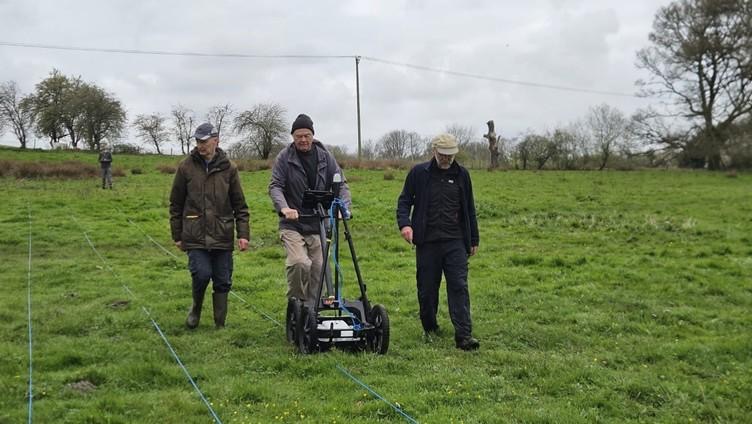
Day #2 and Day #3 both saw amazing progress, but were also very similar – so I have combined the two updates. As for Day# 1 we had “team GPR” led by Philip collecting geophysics survey data using the Mala Ground Penetrating Radar, this time on the pasture we surveyed before Christmas with an earth resistance survey. Figure 1 shows “team GPR” in action. Philip will processing the data collected during this week over the long weekend, which will give us more information on where to open trenches to address our research questions. Watch this space…!
The earth resistance survey of the excavation site collected on day #1 didn’t reveal any new anomalies relating to the masonry wall discovered in the last week of season #1 – so we decided to revert to the “old school”/tried and tested method of re-opening Trench 4e and the test pit from 2025 where the masonry wall was recorded. This involved a lot of digging to remove the infill, but good progress was made by the end of Day#3 as can be seen in Figures 2 and 3.
The layer of Terram fibre placed over the masonry wall prior to filling in Trench 4e provided a clear marker protecting the archaeology revealed in 2025. This will allow us to quickly pick up where we left off last year. New archaeology, possibly associated with the wall, was also revealed in the south of the trench where it was extended. Depending on the new insights revealed by the GPR survey, this trench will be further extended in the coming week to reveal more of the wall and nearby features associated with it.


In Trench 15 located across the intersection of the Roman road/lane next to “building #3”, good progress was also made. By the end of Day #3 the first hints of the surface of the Roman road were starting to appear, and the overburden revealed three late Roman nummi coins. As these artefacts were found in different locations and recorded as “small finds” within Trench 15, they were not thought to be associated (i.e. part of a single deposit), but part of the wide spread of Late Roman period coins found by metal detectorists across this pasture over many years as recorded on the Portable Antiquities Scheme. Work will continue next week to carefully expose the archaeological horizon using the sections recorded nearby in 2025.
