Part of a series of bulletins from the BAS excavations at Wickham House
Follow the project on our YouTube channel
Attendees: Joanne, Katharine, Sam, Zoe, John M, Lindsey, Beth, Gill, Alessa, Tim H, Stuart, Millie, Doug, Julian, Geoff, Paula and Keith
It was another hot day on site – but once again, with use of gazebos to provide shade across the trenches and with activities such as sieving and reporting taking place in the shade of trees we managed to complete a full day of activity. We were also very lucky to be visited by Sarah Orr (Principle Archaeologist at West Berkshire Council) and Dr Phil Smither (Finds Liaison Officer) who spent the afternoon reviewing the archaeology revealed, inspecting finds discovered and meeting the volunteer archaeologists at work in the trenches.

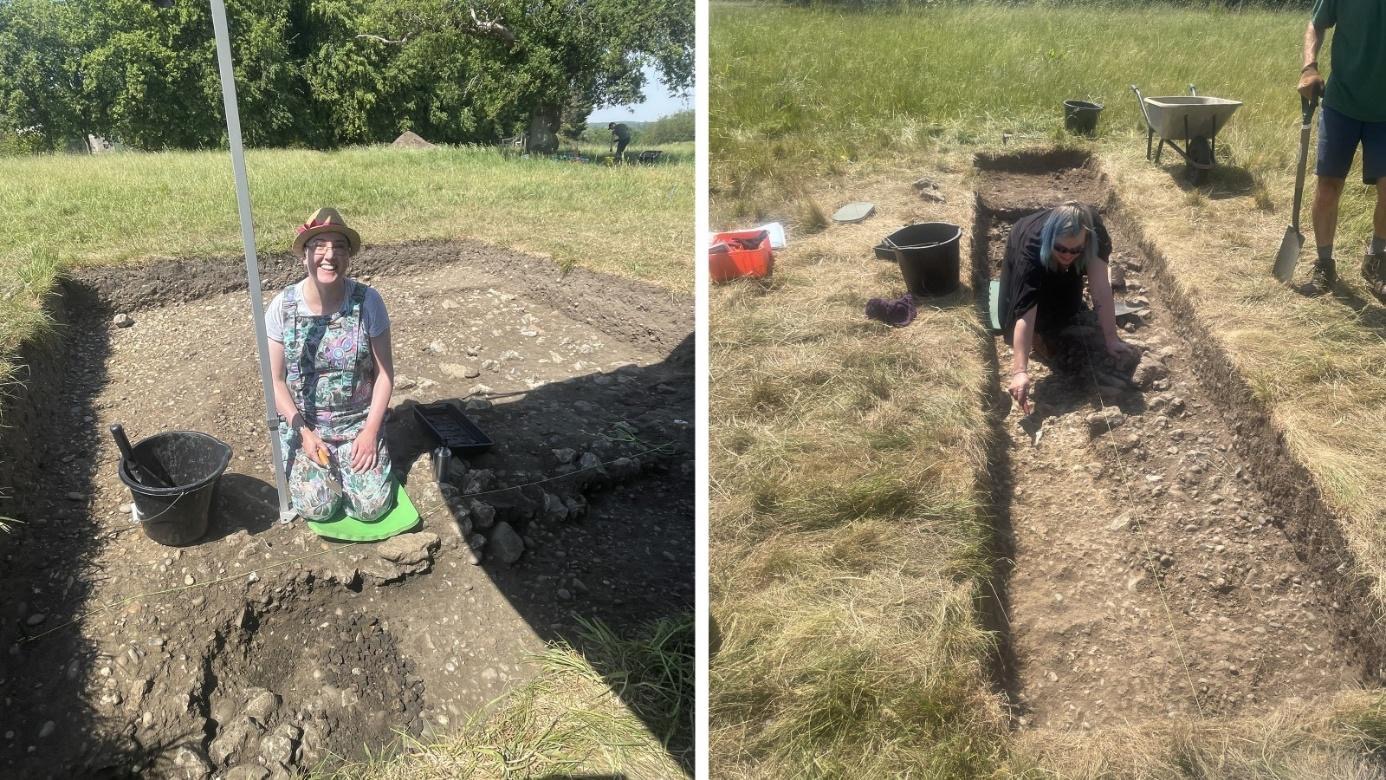
In Trench 15, Sam and Katharine revealed a deposit of large flints in the northeast of the trench which were interpreted as being a deposit of demolition rubble. A coin of Tetricus I found near the bottom of this deposit suggests a possible terminus post quem date of AD270, but of course the deposit could have occurred during the 4thcentury AD or later. The rubble is largely composes of sarsen (as opposed flint) with some stone being of considerable size as seen in Figure 2.

Work continued in Trench 17 to make the sides of the trench vertical in preparation for sections to be drawn next week. It is likely that the midden deposits in this trench span the full period of occupation during the Roman period, and may reveal the evolving character of the settlement and its inhabitants…

Figure 3. Work continues in Trench 17…
In Trench 16 work continued to explore the construction cuts of the corn drier flue to expose is full extent. To the east the remainder of the cobbled surface was removed and the flint/sarsen rubble explored in more detail to determine if it was a dump of material or part of a structure. The surfaces revealed began to be cleaned to see if cuts/pits/post-holes could be observed, but this was difficult in the dry conditions and will be reassessed first thing tomorrow…

Meanwhile in Trench 18, Alessa and Tim continued to clean the clay/pebble surfaces revleaed the previous week, and extended the trench 1m to the south to assess if this surface (believed to be the Roman road) continued to the south of the trench. Surprisingly the road ditch has not yet been located despite this trench being positioned across low earth resistance linear features aligned with the Roman road.