
Part of a series of bulletins from the BAS excavations at Wickham House
Follow the project on our YouTube channel
Attendees: Joanne, Katharine, Sam, Zoe, Stuart, Millie, Doug, Chloe, James P, Martin, Peter Cl, Kate, Claire, Susanne, Eric, Geoff, Dee, Ben A and Keith
Yet ANOTHER hot day on site – but once again, we hunkered down beneath gazebos/trees so work could continue! Next week is forecast to be decidedly damp by comparison, so we may need to find our waterproofs and wellies…
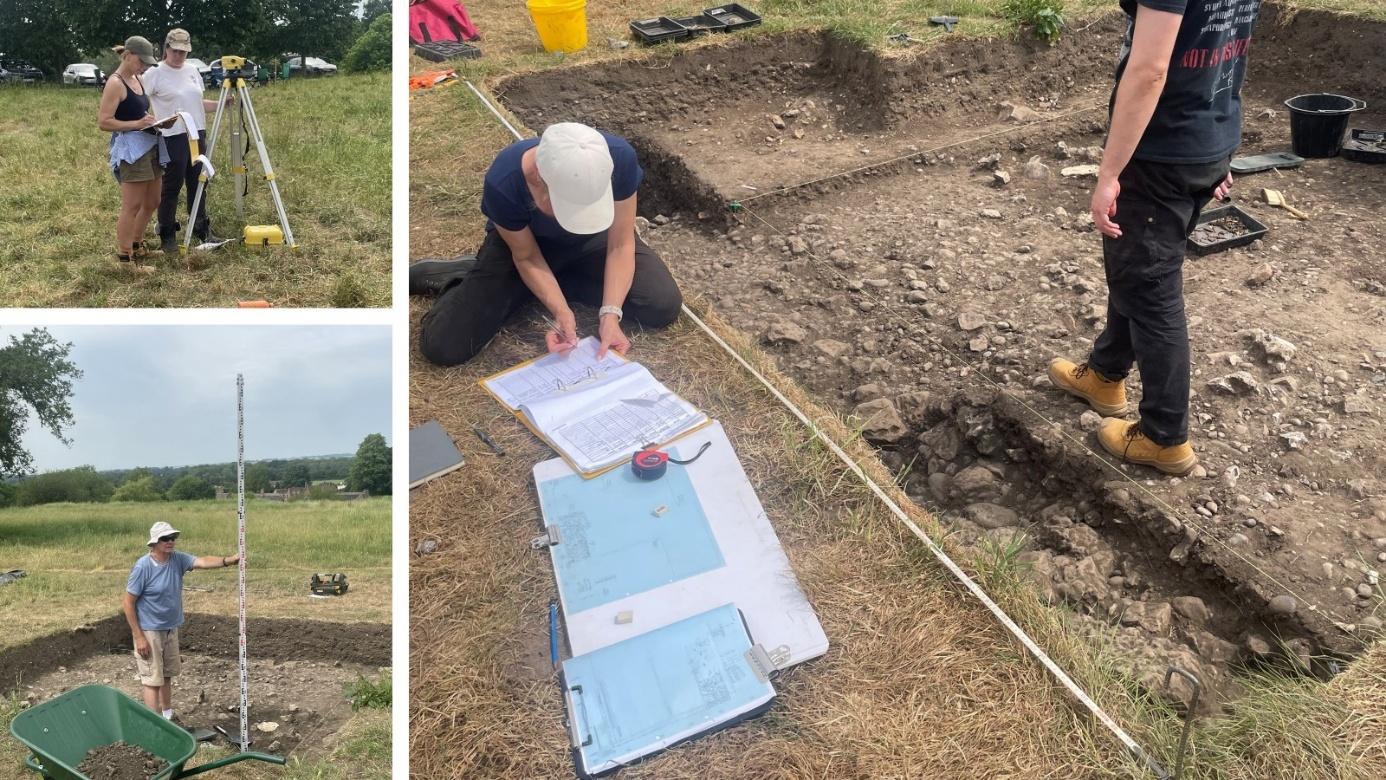
In Trench 17 Chloe, Dee, Doug, Joanne and Zoe spent the morning learning how to accurately draw scale stratigraphic sections of the deposits revealed during the course of the excavation. This process of recording will continue next week for three faces of this trench, and will be used together with the material culture, pottery and bone discovered to characterise occupation of this site during the Roman period.

In Trench 18 Susanne, Eric and Claire completed the recording of the 50% slot dug along this trench and opening new context records for the new features identified beneath. The wetter weather forecast for next week will help to soften the silty/clay material exposed which was heavy going during this week’s hot and dry conditions.

In Trench 15 Sam and Katharine discovered a new context of large sarsen rubble within the slot being excavated at the north end of the trench, which when recorded and removed revealed two distinct contexts beneath. Excavation of this slot will be extended to the east next week to identify the archaeological feature beneath these layers of flint/sarsen where the southerly remains of Building #3 (discovered in 2025) are expected to be found.

Elsewhere in Trench 15 Peter, Martin and Ben were excavating flint/cobble surfaces closer to the ditch of the Roman road/lane, where Peter discovered a Roman As coin. It is hoped that this coin can be accurately dated next week when Lindsey is back on site with us, but initial comparisons suggest a possible 2nd Century AD date

In Trench 16, work continued to define the features of the masonry flue, and to clean the newly revealed surfaces around it. Despite the dry conditions a number of possible post holes/pits were identified that will be investigated further next week when the damper conditions are likely to allow clearer delineation of these features.


Stuart very kindly produced a 3D photogrammetry model using his Poly Cam app of Trench 16, which you can see in 3D on your phone/computer by following the link below:
https://poly.cam/capture/29f23077-2708-47df-8229-3d917ea9817c
